
Evidence-Based Funding: Update & Moving Forward
By: Susan L. Harkin
Chief Operating Officer/CSBO
Comm. Unit Sch. Dist. 300
On August 31, 2017, Public Act 100-0465, the Evidence-Based Funding for Student Success Act (EBF), was signed into law with the intent to “ensure every Illinois student receives a meaningful opportunity to learn irrespective of race, ethnicity, sexual orientation, gender, or community-income level.” Specifically, the legislation aims to:
• Provide resources to every school for a high-quality education.
• Ensure that all students receive the education to graduate from high school with the skills required.
• Eliminate the achievement gap between at-risk and non-at-risk students.
• Satisfy the States’s obligation to assume the primary responsibility of funding public education.
• Reduce the disproportionate burden placed on local property taxes to fund schools.
Many educational advocacy groups supported the legislation. Illinois had long been touted as having one of the least-equitable K-12 public education funding models in the United States due to its over-reliance on property taxes to fund education. The law made sweeping changes how the state would provide funding to its school districts.
As with many legislative bills of this complexity, several items could not be resolved before passage. Instead of delaying the bill, the legislators created a Professional Review Panel (PRP) that would be responsible for addressing these items. The PRP would also be responsible for evaluating whether any increased funding led to improved student outcomes.
Professional Review Panel Duties and Timeline
Public Act 100-0465 Sec. 18-8.15. reads, a Professional Review Panel (PRP) is created to:
• Study and review the implementation and effect of the EBF.
• Recommend continual recalibration of, and future study topics and modifications to the EBF.
The PRP is to make recommendations to the Illinois State Board of Education, the General Assembly and the governor. The handoff to the PRP included everything in the kitchen sink with a very aggressive timeline. Those timelines were as follows:
• Annually, the panel will review the recalibration of gifted, instructional materials, assessment, student activities, maintenance and operations, central office and technology elements.
• Within three years, the panel will review the allocations and funding in the model related to technology, local capacity target and hold harmless.
• Within four years, the panel will review the allocation and funding in the model related to alternative, safe and laboratory schools, college and career acceleration strategies and special education.
• Within five years, the panel will review the allocation and funding in the model related to comparable wage index, maintenance and operations, at-risk student definition, poverty concentration funding and benefits.
• Within five years after implementation, the PRP is required to complete a study of the entire Evidence-Based Funding model to determine whether or not the formula is achieving state goals.
• Items assigned with no specified time in the statute included an annual spending plan and early childhood.
Professional Review Panel Members
There are 27 members on the panel. Voting members are appointed by both the state superintendent and non-voting members are appointed by each of the four General Assembly caucus leaders and the governor. The state superintendent appointments include representatives from school districts and communities reflecting the geographic, socio-economic, racial and ethnic diversity of this state. The state superintendent is also required to ensure that the membership of the panel includes representatives with expertise in bilingual education and special education.
The PRP members are as follows:
• Legislative – Two state representatives, two state senators, Office of the Governor representative
• K-12 Education – Two board members, two superintendents, two school business officials, two principals, two regional superintendent of schools, two educators, Chicago Public School representative
• Advocacy – Two teacher union leadership (IEA/IFT), two educational advocate representatives
• Others – Two at-large representatives, special education representative, Parent Teacher Association representative, state college representative
The panel members provide a broad-based representation of educational constituents.
First Year: Panel and Committee Work – Is the Funding Model Working?
The Illinois EBF model is relatively complex. The first portion of the model calculates an adequacy target or dollars necessary to educate their students based upon 34 unique cost factors for each school district. The second portion of the formula measures a district’s local resources in comparison to the adequacy target. The last part calculates how far a district is from its adequacy and assigns a tier to allocate additional state funding. Districts that are the furthest away from their adequacy target are to receive the most tier funding.
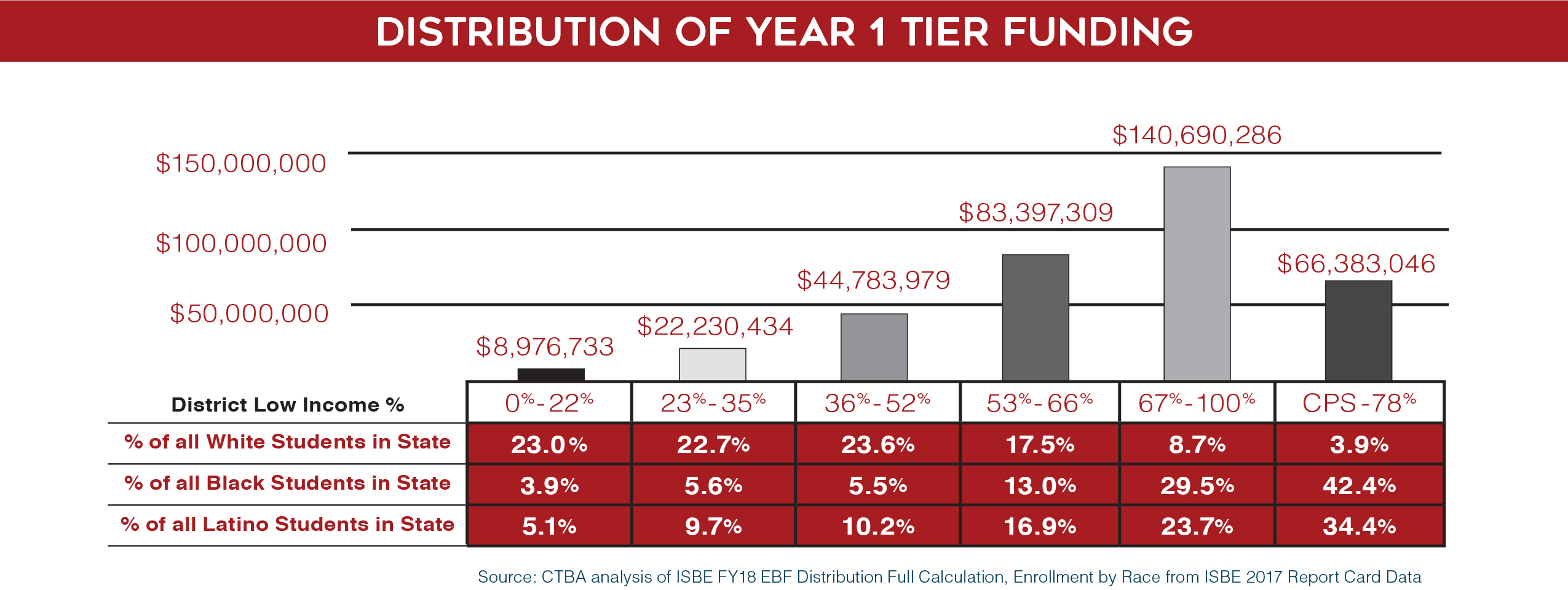
Upon the first review of the distribution of new tier state funding, the model did address getting funding to school districts that were the furthest away from adequacy. As indicated in ISBE’s FY18 EBF Quick Facts, 89% of the $366.6 million of new state funding went to the districts farthest away from adequacy. As shown in Figure 1, 79% of the new FY18 funding went to districts serving at or above 53% low income, 85% of all black students and 75% of all Latino students in Illinois.
While the funding model is providing additional resources to the intended student population, the annual $350 million that is currently allocated will not fully fund the model until FY51. The State made an initial promise to fund the model in 10 years. As shown in the chart below, the State will need to increase its funding by $8.6 billion to achieve its promise.
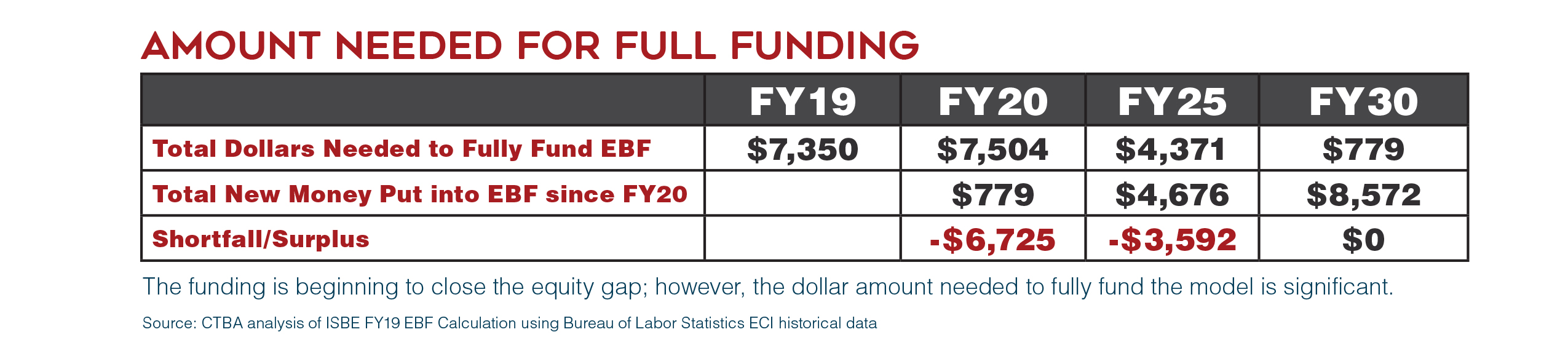 The funding is beginning to close the equity gap; however, the dollar amount needed to fully fund the model is significant.
First Year: Committee Work
The panel had its first meeting in June of 2018. Due to the aggressive timeline outlined in the law, six committees were established to begin working on the items handed off to the panel.
These committees included:
• Equity — Responsible for ensuring that the elements and distribution of EBF addressed equity and would review all recommendations through a lens of equity.
• Evaluative Study — Responsible for developing the research framework that would be used to evaluate whether the formula was meeting the state’s educational goals.
• Format and Scope of the Annual Spending Plan — Responsible for evaluating that data should be part of the Annual Spending Plan.
• Recalibrate per Pupil Elements — Responsible for evaluating the per-pupil amounts in the formula and recommending a recalibration if deemed appropriate.
• ROE Committee — Responsible for addressing funding for our alternative schools within the model.
First Year: ROE Committee Recommendation
Alternative schools provide optional educational programs for expulsion eligible, truant and alternative learning students. As mentioned before, additional funding through the model is based upon a local education agency’s tier funding level. Since alternative schools do not receive local funding, they cannot be assigned a tier or receive tier funding. Some of the panel members believed this was an oversight in the model, and there was an easy fix to allow them to receive tier funding.
The ROE Committee brought a recommendation to September 2019 PRP meeting. At the meeting, the proposal was not received with a warm reception from the panel members. Some panel members had strong opinions about making any changes to the formula so early into the implementation. These opinions ranged from wondering why this issue was being prioritized over other PRP items to not wanting to allow alternative schools access to tier funding.
The PRP narrowly approved a temporary proposal to provide tier funding to portions of the alternative school programs. However, not getting more funding to the at-risk students served by our alternative schools was troubling to our legislators. In June 2019, legislators passed legislation to allow alternative schools to receive tier funding for all programs, making the first real modification to the EBF formula.
Second Year: Retooling
On June 14, 2019, PA 101-0017 was signed into law, which made changes to the leadership of the PRP. The legislation named the state superintendent as chair to better align the panel with the State Board of Education. The legislation also made procedural changes to the panel aimed at providing the PRP with the opportunity to focus on specific issues that have the most significant impact on Evidence-Based Funding.
The new law allows the General Assembly and State Board to “assign” study topics to the panel. In addition to these topics, the chairperson may direct the panel to study existing assigned issues. The panel is also now responsible for a quinquennial evaluative study. The PRP currently has four working committees to continue the work passed off to them. Those committees include the Evaluative Study, Recalibration, Local Capacity Target and Equity Committee.
Professional Review Panel Future
The PRP continues to oversee the new funding model, ensuring Illinois no longer has one of the least-equitable K-12 public education funding formulas in the United States. The aggressive timeline of the panel is now gone. The commitment to ensuring every Illinois student receives a meaningful opportunity to learn irrespective of race, ethnicity, sexual orientation, gender or community-income level still exists. The path to fully funding the model is not resolved.
I believe our legislators are committed to ensuring all students will be provided with a high-quality education and have the required skills upon graduation. I believe our legislators are committed to eliminating the achievement gap between at-risk and non-at-risk students. I believe our legislators are committed to ensuring that the State will assume the primary responsibility and relieve the disproportionate burden placed on local property taxes to fund public education. These commitments are undoubtedly a tall order, but I believe our State’s and the Professional Review Panel’s resolve to do so is commendable.
I encourage all of us to become familiar with the elements in the EBF model. I encourage all of us to dialogue with our administrative teams as to how we are using our EBF dollars and if they are aligned to evidence-based practices. If we want our legislators to keep their commitment, we must show how our additional resources are leading to improved student outcomes. By doing so, we will proudly show that Illinois dared to address its funding formula leading to be one of the best education systems in the nation.
I encourage all of us to dialogue with our administrative teams as to how we are using our EBF dollars and if they are aligned to evidence-based practices.
EBF in Action: How Three Districts are Improving Education
School District U-46 — Elgin, IL
Dr. Jeffrey King, Deputy Superintendent of Operations/CSBO
38,395 Students
White – 26.0%
Black – 6.3%
Hispanic – 54.9%
Asian – 8.3%
Other – 4.5%
Low Income – 61%
English Learners – 34%
IEP Students – 15%
Tier 1 – 59% of Adequacy
FY20 New EBF – $20,592,013
Pros: The greatest thing that the EBF dollars have assisted with is adding educational programs and services at U-46 that other surrounding school districts are providing. It has facilitated discussions at cabinet about evidence-based practices, which have allowed them to modify their five-year plan in areas such as pathways. It has been a thoughtful process to ensure sustainability and fidelity in implementation.
Use: With the new dollars, U-46 has been able to add middle school counselors, add social workers at every school, reduce K-2 class size, add more high school counselors, add elementary assistant principals at half of their schools, add 25 instructional coaches and go to 1:1 computer devices for grades 5-12. They have also increased their capital spend by $10 million as the average age of their schools is 55 years.
Concerns: Overall, the most significant concern is managing how the dollars are spent and being thoughtful in that process to what best supports sustainable student learning. To date, the district has completed an analysis of the U-46 current staffing and dollars spent to align with the elements in the formula to assist with how to spend future dollars.
Wauconda CUSD 118 – Wauconda, IL
William Harkin, Associate Superintendent of Business Services/CSBO
4,636 Students
White – 61.2%
Black – 1.8%
Hispanic – 29.8%
Asian – 3.3%
Other – 4.5%
Low Income – 35%
English Learners – 13%
IEP Students – 15%
Tier 2 – 74% of Adequacy
FY20 New EBF – $235,144
Pros: The greatest thing about the new EBF dollars is the state recognition of districts that are spending below the adequacy level to educate students. The State’s attempt to remedy that by putting additional dollars into the formula and direct those dollars to those districts farthest from adequacy is commendable. The additional dollars are forcing districts to have conversations on how to spend these dollars. It is also taking some burden off local taxpayers who currently provide the majority of their educational funding.
Use: In the first year of implementation, D118 used the dollars to fund construction projects to improve the student learning environment due to the lack of other funding from the State. Discussion on the use of future dollars is focused on the addition of staff to meet the ever-growing needs of their students.
Concerns: D118’s biggest concern is the State’s ability to fund the model going forward.
Comm. Unit Sch. Dist. 300 – Carpentersville, IL
Susan Harkin, Chief Operating Officer/CSBO
21,143 Students
White – 46.6%
Black – 5.5%
Hispanic – 38.6%
Asian – 5.7%
Other – 3.6%
Low Income – 42%
English Learners – 17%
IEP Students – 16%
Tier 2 – 64% of Adequacy
FY20 New EBF $3,314,298
Pros: The greatest pro is providing additional resources in our schools to support learning. The additional dollars have created the opportunity to talk about where our greatest needs are and to allocate resources to address those needs. For the longest time, D300 has been a financially strapped school district doing without many educational programs that would normally be considered a basic service. With our diverse student population, we can now discuss how to provide supports to students with the greatest needs.
Use: D300 has used their additional dollars to hire additional instructional coaches, guidance counselors, interventionists and social workers. We have maintained our elementary average class size ratios at 1:20 students. Our focus has been to improve instruction and provide social-emotional supports to our students. We have also addressed priority safety and security concerns identified in the district safety plan.
Concerns: We are very proud to have all of the district schools designated as exemplary or commendable on our school report card for the past two years. While D300 is committed to using its resources to support evidence-based practices, there are many competing priorities for any additional funding. We feel it is essential to provide flexibility to school districts on how to spend their dollars as we best understand our student needs and district priorities.